

Hey there! As a PA66 yarn supplier, I'm super excited to take you on a journey through the production process of PA66 yarn. It's a fascinating world, full of science and innovation, and I can't wait to share it with you.
Starting with the Basics: What is PA66?
First things first, let's talk about what PA66 is. PA66, also known as nylon 66, is a type of synthetic polymer. It's made from two key monomers: adipic acid and hexamethylenediamine. These two chemicals are like the building blocks of PA66. When they react together under specific conditions, they form long chains of molecules, which give PA66 its unique properties.
PA66 is known for its high strength, good abrasion resistance, and excellent heat resistance. That's why it's used in a wide range of applications, from automotive parts to textiles. And that's where our PA66 yarn comes in.
The Production Process: Step by Step
1. Polymerization
The first step in making PA66 yarn is polymerization. This is where the magic happens! We start by mixing adipic acid and hexamethylenediamine in a reactor. The reactor is like a big pot where the chemical reaction takes place. We heat the mixture to a high temperature and add a catalyst to speed up the reaction.
As the reaction progresses, the monomers start to link together, forming long chains of PA66 polymer. This process is called condensation polymerization because water is produced as a by - product. The reaction continues until we get a polymer with the right molecular weight and properties.
2. Spinning
Once we have the PA66 polymer, it's time to turn it into yarn. This is done through a process called spinning. There are two main types of spinning: melt spinning and solution spinning. For PA66 yarn, we usually use melt spinning because it's more efficient and cost - effective.
In melt spinning, we first melt the PA66 polymer in an extruder. The extruder is like a big screw that pushes the molten polymer through a spinneret. A spinneret is a device with tiny holes in it, kind of like a showerhead. As the molten polymer passes through the holes in the spinneret, it forms fine filaments.
These filaments are then cooled rapidly in a quenching chamber. This solidifies the filaments and gives them their shape. The cooled filaments are then wound onto bobbins or spools.
3. Drawing
After spinning, the filaments are quite weak and have a low orientation of the polymer chains. To improve the strength and other properties of the yarn, we need to draw it. Drawing is a process where we stretch the filaments at a high temperature.
When we stretch the filaments, the polymer chains align in the direction of the stretch. This alignment gives the yarn better strength, elasticity, and other mechanical properties. We usually draw the yarn in multiple stages to achieve the desired properties.
4. Texturizing (Optional)
Depending on the end - use of the PA66 yarn, we may also texturize it. Texturizing is a process that gives the yarn a crimped or curly structure. This makes the yarn more bulky, soft, and absorbent.
There are several methods of texturizing, such as false - twist texturizing and air - jet texturizing. In false - twist texturizing, the yarn is twisted in one direction and then heat - set. The twist is then removed, leaving the yarn with a crimped structure. In air - jet texturizing, high - pressure air is used to entangle the filaments and create a textured effect.
5. Dyeing and Finishing
Once the yarn is spun and texturized (if necessary), it's time to dye it. Dyeing is the process of adding color to the yarn. We can use a variety of dyes, depending on the desired color and the properties of the PA66 yarn.
After dyeing, we may also apply some finishing treatments to the yarn. Finishing treatments can improve the yarn's appearance, feel, and performance. For example, we may apply a softener to make the yarn feel softer, or a water - repellent finish to make it more resistant to water.
Our Product Range
As a PA66 yarn supplier, we offer a wide range of products to meet the different needs of our customers. We have different deniers (thicknesses) of PA66 yarn, as well as different types such as draw - textured yarn (DTY) and fully - drawn yarn (FDY).
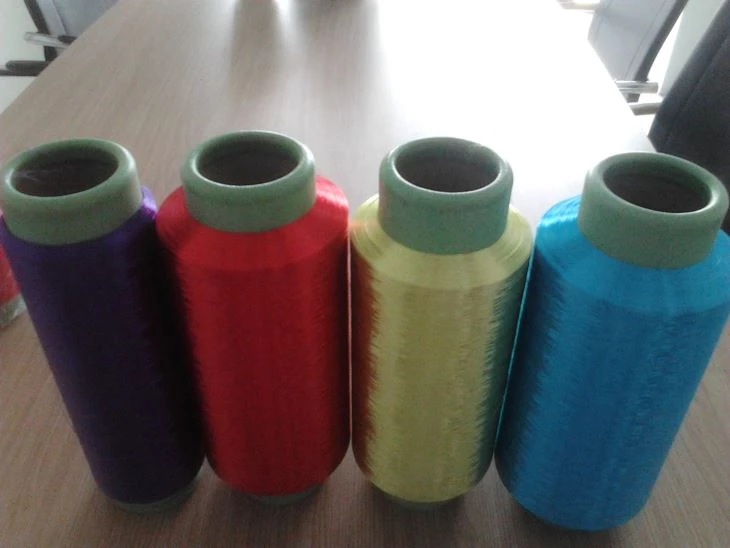

If you're interested in other types of nylon yarn, we also have Nylon6 Dope Dyed DTY AND FDY Yarn for socks, cloth, fabric and so on and DTY AND FDY polyamide Nylon56 Dope Dyed Yarn or PA 56 yarn. And for those looking for specific filament sizes, we offer Nylon Filament Dope Dyed Yarn 20D /12F,40D/12F/2PLY, 70D/24F/2PLY.
Why Choose Our PA66 Yarn?
There are several reasons why you should choose our PA66 yarn. Firstly, we have strict quality control measures in place. From the raw materials to the finished product, we test every step of the production process to ensure that our yarn meets the highest quality standards.
Secondly, we have a team of experienced professionals who are dedicated to providing the best products and services. We can offer customized solutions to meet your specific requirements. Whether you need a special denier, color, or finish, we can work with you to develop the right product.
Finally, we offer competitive prices and fast delivery times. We understand that time is money in business, so we strive to get our products to you as quickly as possible.
Contact Us for Procurement
If you're interested in our PA66 yarn or any of our other nylon yarn products, we'd love to hear from you. Whether you're a small business looking for a reliable supplier or a large corporation in need of bulk orders, we can help. Just reach out to us, and we'll start the conversation about how we can meet your procurement needs.
References
- "Synthetic Fibers: Nylon" by The Textile Institute
- "Polymer Science and Technology" by Donald R. Paul and C. B. Bucknall